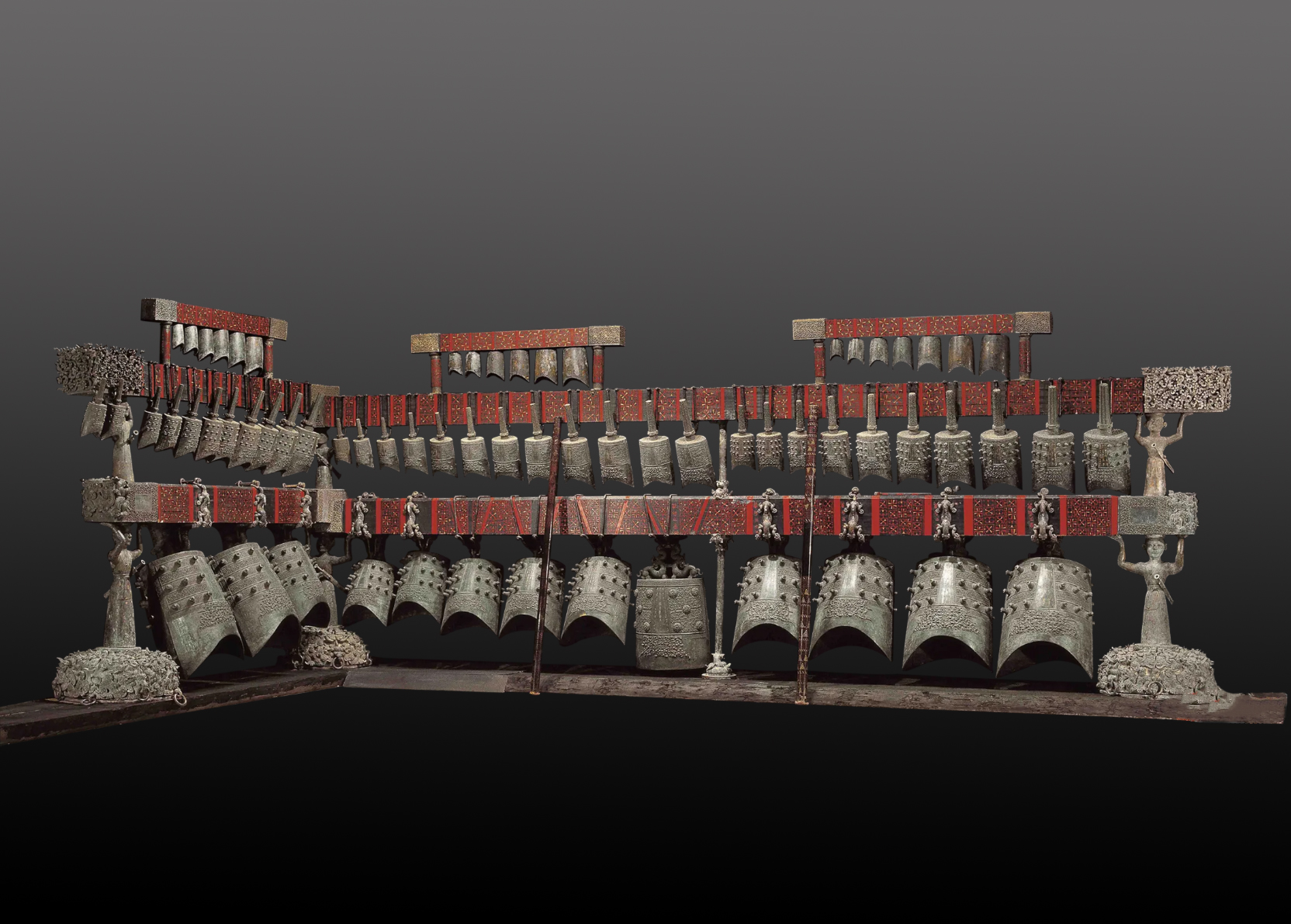
Bianzhong of Marquis Yi of Zeng
Introduction
The bianzhong of Marquis Yi of Zeng is a set of ancient bronze chime bells unearthed in 1978 from the tomb of Marquis Yi of Zeng in Suizhou, Hubei province, China. Dating back approximately 2,400 years to the early Warring States Period (475–221 BC), this musical instrument is a significant archaeological find. Comprising 64 bronze bells, the bianzhong provides insights into ancient Chinese musical traditions, the mathematical relationships in music, and the cultural characteristics of the Zeng state. The instrument is inscribed in the UNESCO Memory of the World Register, acknowledging its cultural and historical importance.
Historical Background
Historical Context of the Warring States Period
The bianzhong of Marquis Yi of Zeng originated during the Warring States Period (475–221 BC), a period of political fragmentation and cultural development in ancient China. This era followed the Spring and Autumn Period (770–476 BC) and involved the division of the Zhou Dynasty's territory into several competing states. The state of Chu, located in present-day Hubei province, was among the more powerful and culturally influential.
The Zeng state, where Marquis Yi ruled, was a vassal state under the influence of the Chu state. While relatively small, Zeng played a role in the cultural and political landscape of the time. The tomb of Marquis Yi, along with its artifacts, offers a glimpse into the life, governance, and artistic endeavors of this state.
Discovery and Excavation
The tomb of Marquis Yi of Zeng was discovered in 1978 during construction in Suizhou, Hubei province. The excavation, conducted by the Hubei Provincial Institute of Cultural Relics and Archaeology, revealed over 15,000 artifacts, including bronze ritual vessels, lacquerware, jade ornaments, and musical instruments. The bianzhong was among the most prominent finds.
The discovery of the bianzhong provided information about the technological and artistic capabilities of the Zeng state and helped clarify the relationship between the Zeng and Chu states. Inscriptions on other artifacts from the tomb confirmed Zeng as a vassal state under Chu's influence, addressing historical questions.
Description of the Bianzhong
The bianzhong of Marquis Yi of Zeng is a musical instrument composed of 64 bronze bells of varying sizes, arranged in a three-tiered wooden frame. The largest bell measures 153.4 cm in height and weighs 203.6 kg, while the smallest is 20.4 cm tall and weighs 2.4 kg. The bells are cast and decorated with patterns, inscriptions, and motifs, reflecting craftsmanship and artistic expression.
Each bell in the bianzhong is designed to produce two tones, depending on where it is struck. This dual-tone capability is achieved through the elliptical cross-section of the bells and tuning during the casting process. The instrument covers a range of five octaves, allowing for the performance of musical compositions.
The inscriptions on the bells provide information about their tuning, musical scales, and the mathematical relationships between the tones. These inscriptions are considered early records of such knowledge and demonstrate an understanding of acoustics and music theory.
The bianzhong was likely used in ceremonial and ritual contexts, potentially as a symbol of the Marquis's authority and the cultural characteristics of the Zeng state. Its size, complexity, and craftsmanship suggest its importance in courtly life and the technological and artistic capabilities of the Warring States Period.
Cultural and Historical Importance
The bianzhong of Marquis Yi of Zeng holds cultural and historical significance as an example of ancient Chinese craftsmanship and as a source of information about early Chinese music, mathematics, and society.
Musical Aspects: The bianzhong represents an early example of a developed musical instrument capable of producing a range of tones. Its inscriptions provide insights into the musical scales and tonal systems of ancient China, highlighting an understanding of acoustics and music theory during the Warring States Period.
Technological Aspects: The casting and tuning of the bronze bells required metallurgical expertise and precision. The dual-tone capability of the bells indicates ingenuity and skill.
Cultural Aspects: The bianzhong may have served as a symbol of the Marquis's authority and the cultural characteristics of the Zeng state. Its use in ceremonial and ritual contexts suggests its importance in social and political life.
Historical Aspects: The inscriptions on the bells and other artifacts from the tomb provide information about the relationship between the Zeng and Chu states, the governance of the Zeng state, and the broader cultural and political landscape of the Warring States Period.
Global Recognition: The inclusion of the bianzhong in the UNESCO Memory of the World Register acknowledges its cultural importance. It connects ancient Chinese civilization with the modern world, promoting an appreciation of China's cultural heritage.
Preservation and Display
The bianzhong of Marquis Yi of Zeng is housed in the Hubei Provincial Museum in Wuhan, China. The museum, established in 1953, is dedicated to preserving and showcasing the region's history and heritage.
Due to the delicate nature of the bells, they have been played a limited number of times since their discovery—in 1978 and 1984. Subsequent research indicated that these performances caused minor damage, leading to the decision to prohibit further use. To ensure their preservation, the original bells are no longer exhibited overseas and are displayed under controlled conditions at the museum.
To allow the public to experience the music of the bianzhong, replicas have been created and distributed to other museums. Additionally, the Hubei Provincial Museum has an orchestra specializing in bianzhong music. This orchestra has performed in several countries, promoting the cultural significance of the instrument and enabling audiences to appreciate its sound.
The discovery and preservation of the bianzhong of Marquis Yi of Zeng have contributed to our understanding of ancient Chinese culture and inspired research and appreciation of China's musical and artistic heritage. Its legacy continues to be relevant, connecting the past and present and linking people across cultures.








